
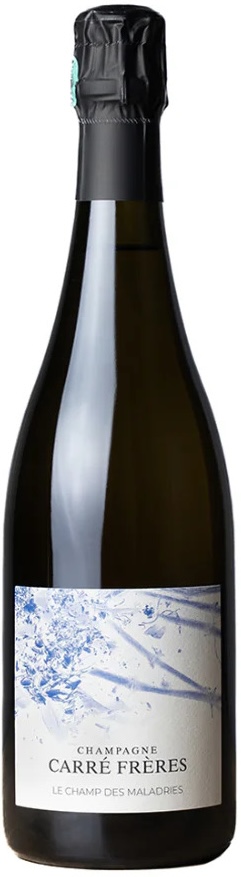
75cl
Champagne Carre Freres Le Champ Des Maladries 2021
Vendor code : 1997
We offer a rare opportunity to explore Champagne Carre Freres Le Champ des Maladries — a precise, single-parcel expression shaped by barrel ageing, rarely available on the market.
Not available
Carre Freres Le Champ des Maladries 2021 is a grower Champagne produced by Edouard and Victor Carre, combining fruit from Trépail Premier Cru (“Le Champ Jeanvrai,” planted in 1964) and Verzy Grand Cru (“Les Maladries,” planted in 2005). The blend is 60% Chardonnay and 40% Pinot Noir, bringing together two distinct terroirs. The wine is aged for around 11 months in 300L barrels, followed by approximately 30 months on lees. Extra Brut dosage at around 2 g/L keeps the style focused and precise, with a clear emphasis on chalk and terroir expression. Drink Date: 2025 - 2034.
Carré Frères started in 2019 with just two barrels of Côteaux Champenois. Today, the project has already moved forward to its first Champagnes from the 2020 vintage — a clear shift from experiment to direction. Separate from Champagne Vincent Carré, this is a focused, personal venture led by two brothers: Edouard, in charge of vinification, and Victor, who works both in the vineyards and in the cellar. Their foundation was built around 2015 at their parents’ 23-hectare estate, but it didn’t take long to realise their approach would go its own way. The vineyards remain within the family: their mother inherited parcels in Verzy, while their father owns vines in Trépail, where the winery is based. Farming overall stays conventional, but the parcels used for single-vineyard bottlings receive more precise attention, including ploughing and more hands-on work. Today, the brothers focus on around four hectares and vinify exclusively in oak. At the beginning, this was partly out of necessity — the 2020 vintage was aged entirely in new barrels — but as their own cellar builds up, the role of oak is gradually becoming more integrated and less dominant. The barrels come mainly from Tremeaux and Damy, mostly 300 liters with some 450-liter formats. Fermentation is carried out with selected Champagne yeasts, with sulfur added at pressing and before bottling to secure stability over time. The result is a style that stands out immediately: structured, precise, and firmly built, with a clear imprint of new oak — wines that feel intentional, focused, and designed to evolve.
Reviews from critics
91/100
1 points
95-100
0
90-94
1
85-89
0
80-84
0
75-79
0
0-74
0
Wine Advocate
The NV Le Champ des Maladries (2021), a blend of fruit from Le Champ Jeanvrai in Trépail and Les Maladries in Verzy, was disgorged in December 2024 with a dosage of two grams per liter. Aged in a combination of 40% new 450-liter barrels and 60% one-year-old 300-liter barrels, it bursts with aromas of citrus oil, smoke, dried white flowers and buttered toast. Medium to full-bodied, it features an incisive spine of acidity, a layered core of fruit and a pillowy mousse and concludes with a long, focused finish. It is one of the most harmonious efforts produced by the young winemakers to date.
Not available